ocean-graft: a full checkout per coding agent, in milliseconds
Copy-on-write session volumes for running coding agents in parallel. Each agent gets its own branch, its own .git, installed dependencies and its own port, and stores only what it changes.
Install
As a Claude Code plugin, from a terminal:
claude plugin install ocean-graft --marketplace viveky259259/ocean_fsFor Codex, Cursor, Gemini CLI, OpenCode or any MCP client, install the binary and register it:
curl -fsSL https://graft.getocean.dev/install.sh | sh
cd your-repository
ocean-graft setup all
The installer downloads the binary for your machine (macOS on Apple Silicon or Intel, Linux on x86_64 or arm64) from the latest GitHub release and checks it against that release's SHA-256 list. A binary that does not match is never installed. Read the script.
How you use it
cd ~/code/my-app
ocean-graft init --setup "npm ci"   # once: clone + install into the template
ocean-graft new search              # ~1.5 ms, warm, on branch ocean-graft/search
ocean-graft new tags
cd "$(ocean-graft path search)"     # point an agent here
ocean-graft ls                      # what every session has changed
ocean-graft conflicts               # overlaps and real conflicts, before anyone commits
ocean-graft import --all            # commits come back as ocean-graft/<name> branches
Measured
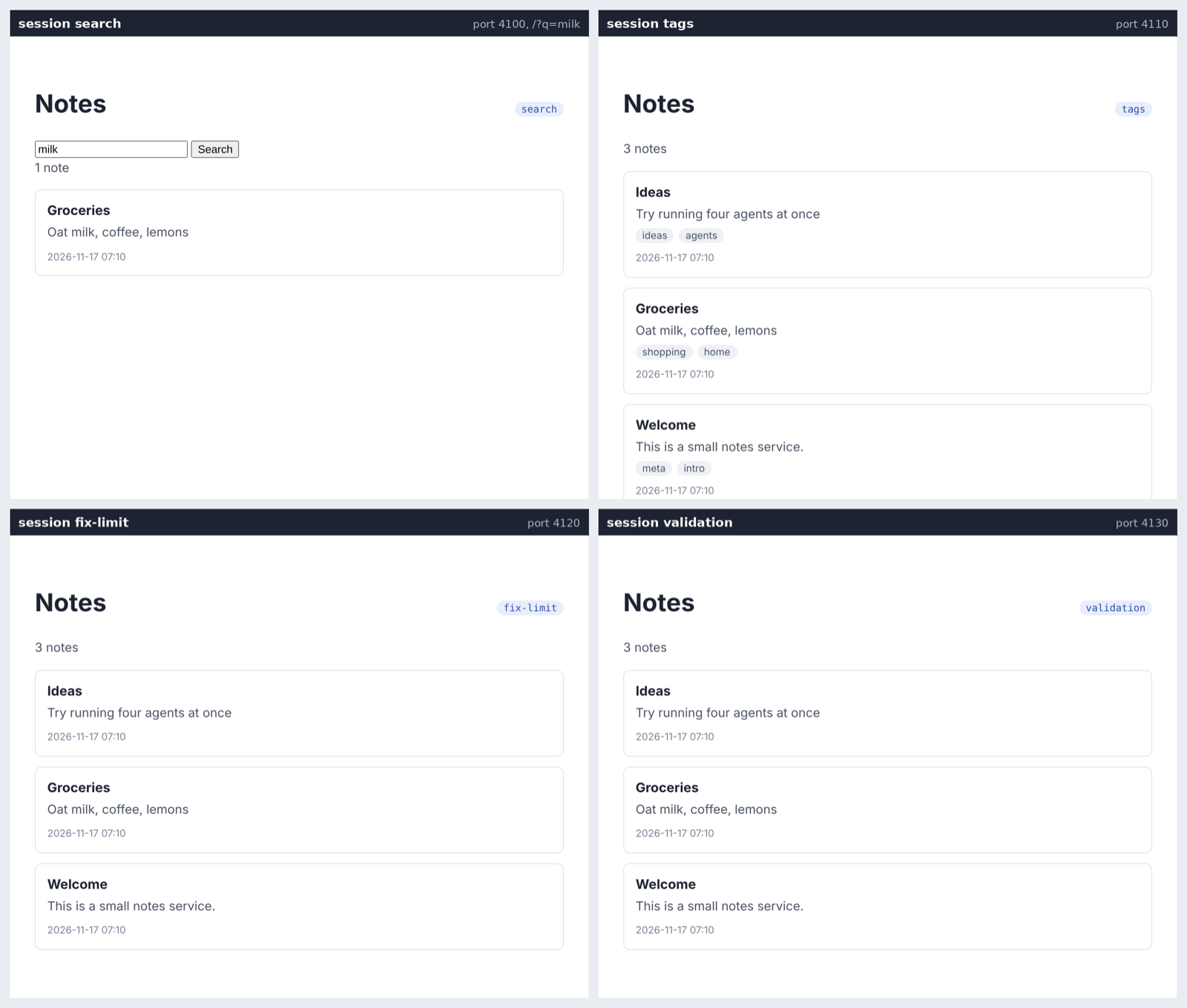
Four agents worked one repository at once, one session each. ocean-graft conflicts found which pairs really conflicted before anything was merged, and all four dev servers ran side by side, each serving only its own change.
What the agent gets
Through the plugin or ocean-graft mcp, the agent operates ocean-graft itself:
| Tool | What it is for |
|---|---|
status | The project, every session, checkpoints, services, overlaps |
fork | New sessions from the repository, a session or a checkpoint; count for best-of-N |
checkpoint / rewind | Save a state before a risky step; go back (a rewind can itself be undone) |
conflicts | Which sessions would collide, before landing any |
land | Rebase onto your branch, run the tests, fast-forward; never force |
preview | Start the session's dev server and hand you a URL |
discard | Remove a session, saving its work to a branch first |
In Claude Code, hooks also give every claude --worktree session and every isolated subagent its own ocean-graft session, and checkpoint at the end of each turn.
Limits worth knowing
The overlay backend needs root on Linux; as an ordinary user ocean-graft uses reflink copies, which are full copies on filesystems without reflinks. --sandbox keeps an agent's commands from writing outside its session by mistake; it is not a security boundary against a hostile program and does not restrict the network. The full list is in the README.